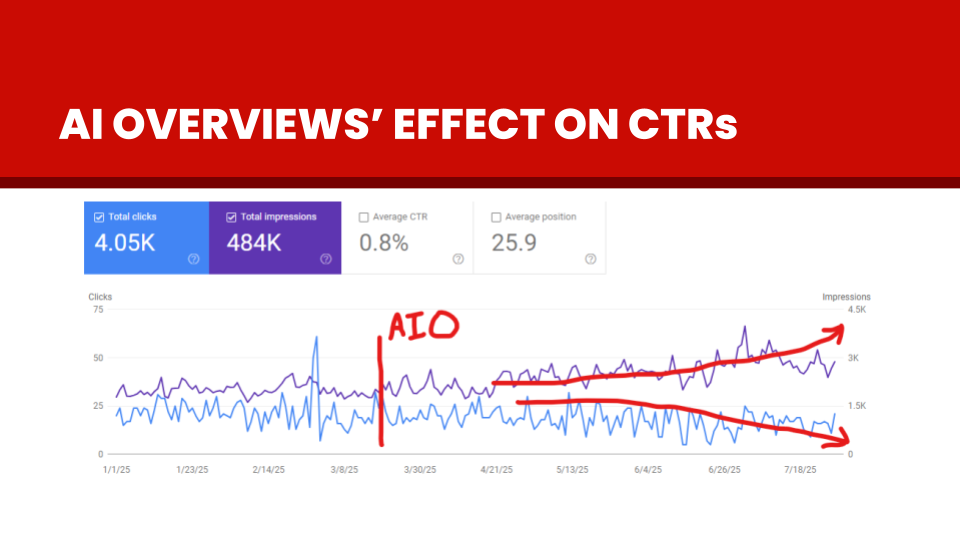
AI SEARCH ISN'T THE FUTURE—IT'S THE PRESENT
A year ago, you could reasonably say “AI is the future of search.” But you can’t say that in the Year of Our Lord 2026. That future has already arrived. If you’re not thinking about your visibility in AI search, it’s time to start.
The Rise of AI Search
Once upon a time, Google was our sole source for finding products, services, and information online. It was so ubiquitous that it became a verb: “Google it.”
If you've been living under a rock for the last three years, you might not have heard of ChatGPT, Gemini, Claude, or OpenClaw. But most of us have heard of at least one of these by now, and many of us have used one or more of them—at least experimentally.
Millions of users are now turning to these systems to search for answers to their questions and even to find products and services online. In other words, people are using ChatGPT alongside—or instead of—Google. That’s no longer a theoretical AI use case; it’s now a meaningfully large share of the digital landscape.
How Big is Google?
The reporting on Google's dominance in search has been somewhat misleading. While it's technically accurate to say that Google still commands around 90% of traditional search, this figure only holds true when AI systems are excluded from the analysis. If we define search strictly as the activities occurring within traditional search engines in web browsers, then yes, Google indeed controls about 90% of that space.
However, deeper analysis reveals that Google is increasingly capturing a smaller portion of a rapidly expanding market. AI is starting to encroach on that share of search.
How Big is AI Search?
The reporting on the size of AI search has also been confusing. A study by Graphite claims that 56% of search volume is now AI search, but that figure is misleading.
First of all, the 56% figure reflects the global share of search, while in the U.S., the number is closer to 34%. Americans appear less enthusiastic about AI than the global average.
Second, not all AI prompts qualify as search. For instance, if you ask ChatGPT to rewrite the lyrics of C.W. McCall's song "Convoy" in Shakespearean English, that's not really search behavior; it's generative behavior. That’s fundamentally unlike anything you would ever do with a traditional search engine.
But if you ask ChatGPT about a product you’re thinking of buying or a service you need, that would be a search-like prompt. Graphite's study indicates that about half of AI prompts fall into this “search-like” category.
All that cashes out to AI systems having captured about 28% of searches worldwide and around 17% in the U.S.
Which Platforms Dominate AI Search?
ChatGPT is currently the dominant player in the AI search landscape, accounting for about 12% of search traffic in the U.S. Given that AI search overall represents only 17% of the market, ChatGPT makes up roughly 70% of that AI segment.
That said, this ecosystem is still in its infancy and highly dynamic. So don’t touch that dial.
What This Means for Your Business
Now is the time for small businesses to be thinking about their visibility in AI Search. 17% of search traffic might not seem significant at first glance, but it's a staggering figure! Nothing has taken this big a bite out of Google since its masthead read “Don’t be evil.” (Those were the days, huh?)
AI's rapid growth shows no signs of slowing down, either. It’s not going to stop at 17%.
Now, you might be thinking, "Sure, people are using AI, but it's not bringing me much traffic." And that’s probably true. Looking at my clients’ analytics, ChatGPT contributed around half a percent of their site traffic over the past 90 days, with other AI systems adding another quarter of a percent.
On the surface, these numbers might not seem impressive, but consider this: traffic from AI searches converts at double the rate of traditional search traffic. And search traffic is already higher than most other traffic channels. The reason for this high conversion rate is because, in AI search, the purchase decision is often made in the chat conversation before users even arrive on your website. So by the time they do arrive, they’re ready to buy.
Now is the prime time to enhance your visibility in AI search. As a marketing channel, AI Search has been around long enough and taken a big enough bite out of Google that we know it’s not a passing fad. But it's also early enough that your competitors are probably sleeping on it.
How to Improve AI Visibility
Are you sold yet? Good. Let’s talk about concrete steps you can take to enhance your AI visibility.
Don’t Skimp on Traditional SEO
The foundation of AI search visibility lies in traditional SEO fundamentals. When you enter a search-like prompt in ChatGPT or any other AI tool, the results you receive—especially product listings or service pages—were gathered from top results in traditional SERPs. While answers to common questions may be derived exclusively from the LLM’s training data, search-like prompts require AI systems to retrieve live data from the internet, such as links to websites. That retrieval is basically a traditional search, often literally a Google search. Your position in these traditional search results directly influences your visibility in AI. Therefore, maintaining your SEO fundamentals is crucial.
Structured Data (Schema)
Your SEO strategy must include structured data. Many misunderstand the role of structured data in AI, mistakenly believing that AI systems process structured data better than plain text. In reality, AI is designed to easily ingest plain text. But when a search prompt returns live results, the AI needs to understand not just the content, but the shape of your site's data in order to generate those rich snippets in the chat window.
A few months ago, I wanted to take a short vacation with my wife. I knew the kind of results Google would provide, so I decided to see what ChatGPT could produce. I searched for lodging near our destination, and it generated a rich snippet right in the chat thread, including a map of hotels, with descriptions and price ranges for each of them. It was easily able to generate those snippets thanks to the structured data available for those destinations. That’s how you want ChatGPT discussing your products and services to your target customers.
LLM-Friendly, Human-Centered Content
Additionally, content differentiation has become an even higher priority. Generative AI has lowered the barrier for content creation, which has led to an oversaturation of low-quality AI slop all over the web. In that slop-filled environment, standing out with high-quality, human-centric content is more important than ever.
At Longtail Dragon, we’ve solved this problem by engineering our “expert interview approach” to content creation. By utilizing interviews with our clients—who are subject matter experts on their own businesses—we produce content that preserves their authentic voice and expertise, creating articles that AI cannot replicate. This approach not only showcases their authority but also ensures the content is digestible for AI with short “chunked” paragraphs, TL;DR summaries, and clear headlines.
And Many More
There are other aspects of AI optimization, mostly having to do with increasing the size of your brand’s online footprint. But the tips in this article will get you a long way towards increased AI visibility.
Choosing the Right AI Search Optimization Partner
If you’re in conversations with an SEO or AI SEO professional, one simple “tell” is to ask them how they go about differentiating their content in a sea of AI slop. Then listen for an answer that uses the word “human” at least once. This is a really low bar to clear, but you’d be amazed by how many can’t clear it. Few firms—if any—will have a content creation process as cool as our expert interview approach, but if they don’t include human authors or at least human copy editors in the content pipeline, they probably aren’t worth your time.
Conclusion
The rise of AI search is reshaping the digital marketing landscape in ways that demand immediate attention. Embracing AI SEO strategies now is not just an option; it's a necessity for small businesses aiming to thrive in the modern marketplace. While the current share of AI search traffic may seem modest, the potential for conversion and engagement is staggering, presenting a unique opportunity to stand out in a crowded market.